Remembering on purpose
A memory model for every note on the fretboard, reviews timed to when you are about to forget, honest grades, and a Review Raid to clear what is due.
Written in retrospectCovers: 4 – 15 October 2026
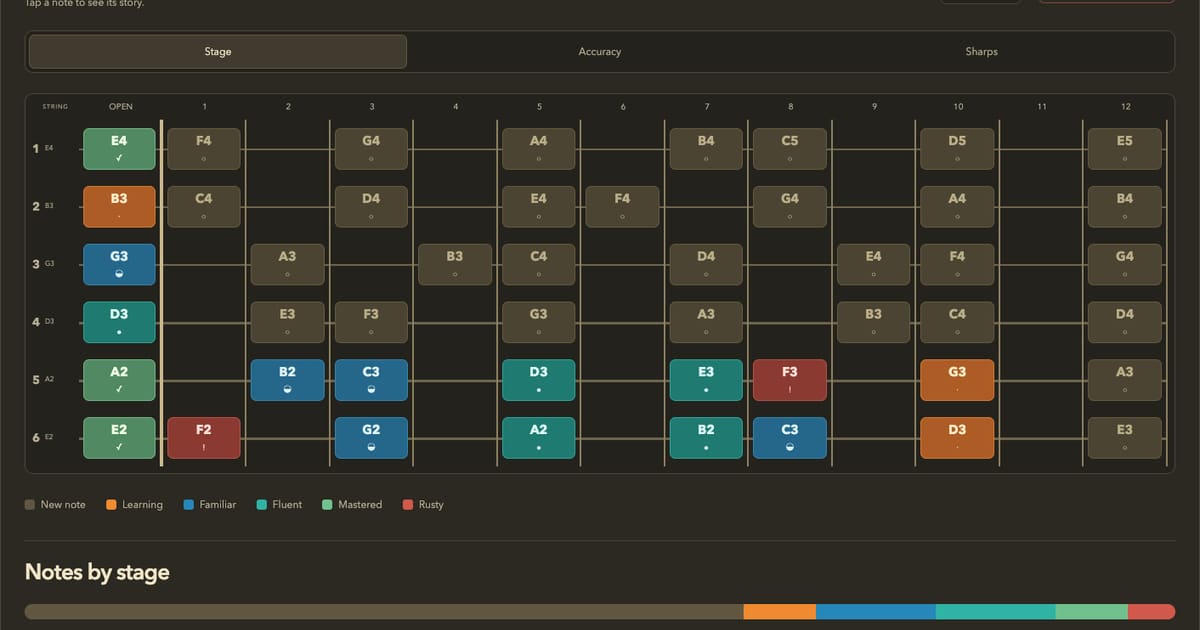
Getting a note right today is easy. Still knowing it next month is the hard part, and it is the part that makes you a musician. This is where we have put the most science into Kaastle.
One memory record per note
On 4 October we rebuilt the learning loop around a single mastery rule, a weighted choice of which question to ask next, and a log of every answer. On 11 October we went further: every position on the fretboard now keeps its own memory record, modelled with FSRS-5, the open-source spaced-repetition scheduler from the Open Spaced Repetition project, with its published default weights.
Each record tracks two things: stability, how many days until your chance of recalling the note falls to 90%, and difficulty. From those, the game knows how likely you are to recall any note right now. When that falls under 90%, the note is due.
Two details matter a lot:
- Only the first answer of the day counts in full. Later answers that day can only pull a note down. Getting the same note right ten times in one sitting cannot make it "known". Memory is built across days, not within one.
- Levels fade. A note's level is read live from its memory record, so if you stop practising, it slips. A note that was once Familiar and falls below 70% recall turns Rusty.
From New to Mastered
The levels you see are plain readings of that record:
- New: never met.
- Learning: met, not yet remembered.
- Familiar: stable for at least a day.
- Fluent: stable for a week, and answered quickly.
- Mastered: stable for three weeks, with three review days in a row whose first answer was right.
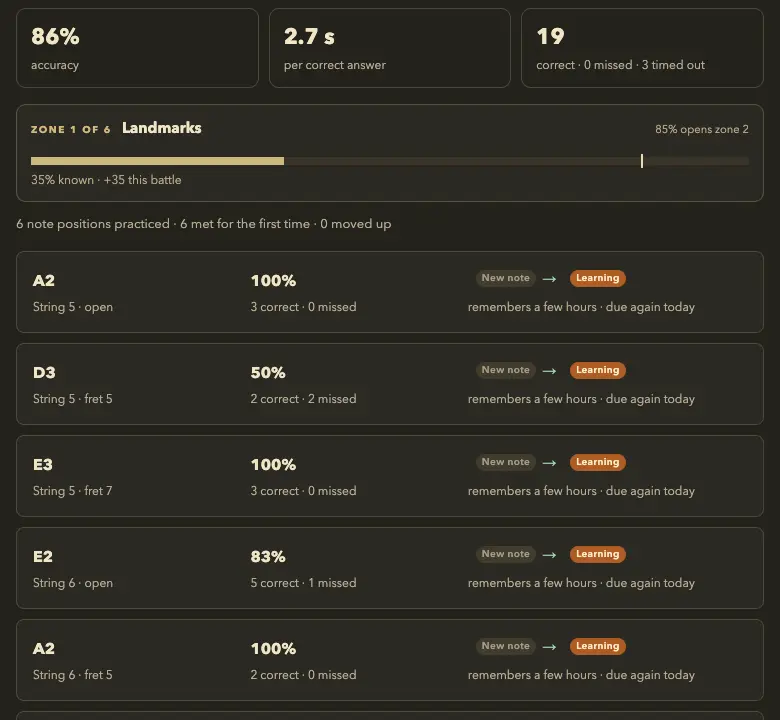
The guided fretboard teaches in zones: first the landmarks (open strings, 5th and 7th frets), then the root strings, the middle strings, the top strings, and last the sharps and flats. A zone opens the next once its average recall reaches 85% and 80% of its notes are Familiar or better. Fret 12 and up are left out of guided practice; from there the board repeats itself an octave higher.
After every battle the report shows what changed in your memory: the zone's progress, each note's level before and after, how long it will be remembered, and when it is due again.
Honest grades
A grade that flatters you does not help you learn. On 10 October battle grades moved to the school letter scale, A to F, and an A needs the answers behind it: at least 90% right and a steady pace, whatever the keep or the difficulty gave. A slow, inaccurate win is not an A, even on Easy, and the result screen tells you what held you back.

Review Raid
Knowing what is due is only useful if reviewing it is something you want to do. On 15 October we added the Review Raid: a battle in which the enemy army is your due notes, one squad for each, most overdue first. Answer a note right and its squad is cleared. With nothing due, a short raid on your weakest notes stands in. It sits on the home page beside the Daily Battle.
The memory model itself knows nothing about music beyond the zones. That is deliberate. The same day, we built a first study set beyond music, Know Your Foe (知己知彼), with questions about the cards themselves. It needs more work, so we have set it aside for now. Our long-term hope is that Kaastle can help you learn many subjects the same way.