Cards and decks
Why your army became a deck of cards, and why every right answer is guaranteed to field the next one.
Written in retrospectCovers: 27 September – 5 October 2026
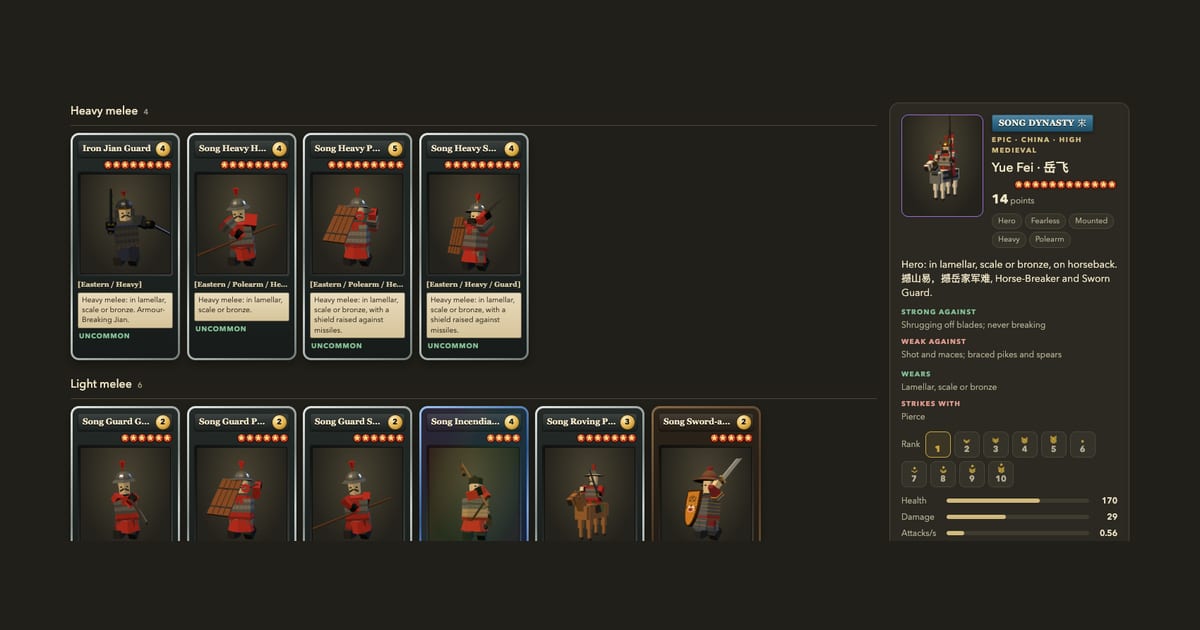
For the first two weeks, the soldiers a right answer summoned were chosen for you. They were drawn by weighted chance from whatever the battlefield allowed. It worked, but it was not yours.
On 27 September we built a unit catalog and a Collection, and cards replaced the old cosmetic "looks". A day later, on 28 September, came decks.
A promise: right answers always field someone
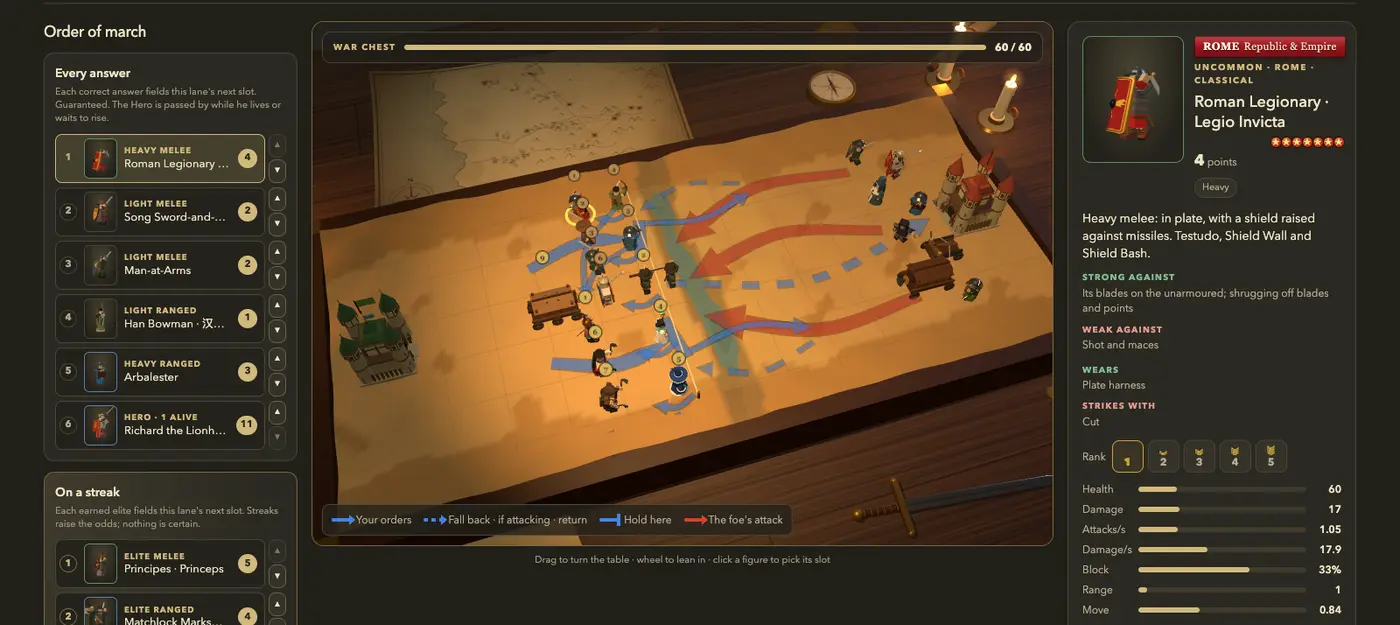
A deck is a plan laid out in two lanes:
- The ordinary lane: every correct answer fields the next card in this lane. It is guaranteed.
- The elite lane: a streak of right answers earns an elite, who fields the next card here. You can raise its pace, but never count on it.
The guarantee was the decision we held to most firmly. Our design notes from that day put it plainly: a sure spawn matters a great deal, and it is far more satisfying. When you play the note, your soldier comes. Every time.
The deck began with ten slots; today it has fifteen, each taking cards of a kind (heavy melee, light ranged, elite cavalry, a hero, a musician and so on). Since 10 October an empty slot still keeps its turn: an empty ordinary slot sends out a levy, a weak one-point man, so the promise holds even for a half-built deck.
Planning in the War Council
Decks are built in the War Council. You set the order of march for each lane and see how your army would deploy on a 3D sand table, with the chosen card's dossier beside it.
What a card is
Each card has a trading-card face, a faction, a rarity from common to mythical, and prowess shown as stars from 1 to 12. Cards cost points: a deck may spend at most 60, and since 5 October must field at least three ordinary cards and two elites.
We set ourselves a few rules early:
- A card sits in one slot only. You cannot stack one strong card everywhere.
- No look-alike cards. If two cards would look the same on the field, one of them should not exist. A card's look must tell you what it is.
- Cards, not variants. Since 1 October every battle, for you and for the AI, marches by decks. There is one system, and it is the one you play with.
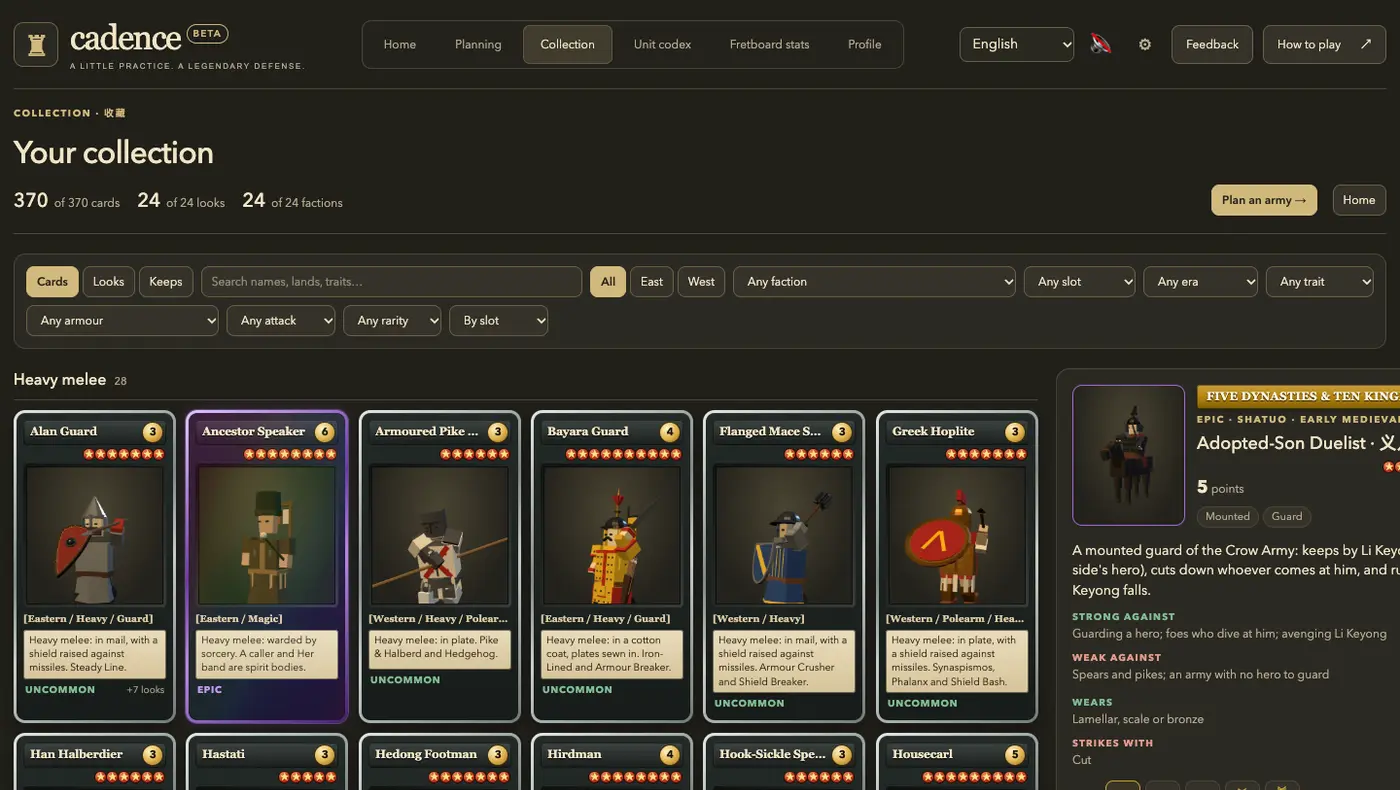
Cards are also where history lives in Kaastle. Each one is meant to be truthful to what it depicts, and that is a story for its own post.